Davide Dametti
Intro to Time Series
Introduction
In today’s data-driven landscape, time series analysis has emerged as a crucial tool for organizations aiming to make informed decisions. At its core, a time series consists of data points collected at consistent intervals, enabling businesses to track trends, patterns, and fluctuations over time. By effectively harnessing this data, companies can uncover valuable insights that improve operational efficiency and guide strategic planning.
This note will introduce the concept of time series, starting with a clear definition and relevant examples to clarify its significance. We’ll examine why time series analysis is important across various industries and how it can enhance business processes. We’ll also explore its key applications, including descriptive analysis, predictive forecasting, and anomaly detection, demonstrating how these techniques address real-world challenges.
What is a time series?
A time series is a collection of data points indexed in chronological order, capturing the behavior of a specific variable over time. This data can be gathered at regular intervals, such as hourly, daily, monthly, or yearly, allowing for a systematic analysis of how that variable evolves. Unlike static datasets, which offer a snapshot of a situation, time series data enables us to observe patterns, trends, and cycles that may not be apparent in other forms of data.
For example, daily temperature readings can be compiled into a time series to analyze seasonal changes, while weekly sales figures can highlight trends in consumer behavior. Other examples of time series include stock market prices recorded every minute, annual revenue reports for a business, or monthly unemployment rates. By organizing data points chronologically, time series analysis facilitates the exploration of relationships and dependencies over time, making it a valuable tool for understanding complex phenomena in various fields, including finance, economics, healthcare, and environmental science.
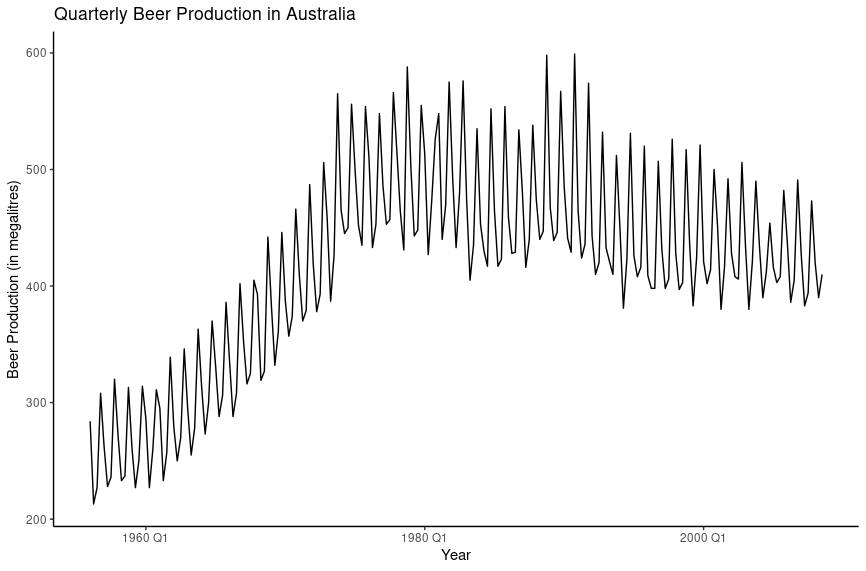
Dataset available in the fpp3 R package under the name "ausbeer", and documented here
Industry use cases
Time series analysis is crucial for organizations and industries that rely on historical data to inform decision-making and strategic planning. By examining time series data, businesses can identify underlying trends and patterns that help them understand past behaviors and anticipate future developments. This understanding is vital in today’s fast-paced environment, where timely decisions can significantly impact competitive advantage and operational efficiency.
In the finance sector, time series analysis plays a pivotal role in forecasting stock prices and assessing market trends. Financial analysts use various time series models to analyze historical price movements, enabling investors to make informed decisions about buying, selling, or holding assets. This predictive capability is crucial for risk management and investment strategies, as even slight changes in market conditions can have significant financial implications.
In the retail industry, companies leverage time series data to optimize inventory levels and improve supply chain management. By analyzing sales data over time, retailers can identify seasonal trends and fluctuations in consumer demand. This demand forecasting helps reduce lost sales by ensuring that popular products are in stock during peak seasons while minimizing inventory costs for less popular items. Such data-driven decisions can enhance customer satisfaction and boost overall profitability.
The energy sector also heavily relies on time series analysis to manage supply and demand effectively. Utility companies track electricity consumption over time to identify peak usage periods and seasonal trends. By analyzing historical data, they can forecast future energy demand, allowing for more efficient production planning and resource allocation. This predictive capability helps prevent shortages or surpluses, ultimately ensuring a reliable energy supply. Additionally, time series analysis can assist in monitoring renewable energy sources, such as solar or wind, by analyzing patterns in energy generation based on weather conditions.
Overall, time series analysis provides valuable insights across various sectors, driving better outcomes and making it an indispensable tool in today’s data-driven landscape. By understanding and leveraging time series data, organizations can enhance their strategic planning, operational efficiency, and overall effectiveness.
Common applications
Time series analysis has a wide array of applications across different fields, primarily focusing on descriptive analysis, predictive forecasting, and anomaly detection. Each of these applications plays a critical role in helping organizations make data-driven decisions.
Descriptive Analysis is one of the fundamental applications of time series analysis. By examining historical data, organizations can gain insights into patterns and trends over time. For instance, businesses can use time series data to understand seasonal sales fluctuations, identify growth trends, or evaluate performance metrics over different time periods. This type of analysis provides a comprehensive view of how variables behave, allowing companies to make informed decisions based on historical patterns.

Predictive Forecasting is another significant application that builds on the insights gained from descriptive analysis. By utilizing time series models, organizations can forecast future values based on historical data. For example, a retail company might analyze past sales data to predict future demand for products during specific seasons or promotions. This forecasting capability enables businesses to optimize their operations, allocate resources effectively, and anticipate market changes, ultimately driving better business outcomes.
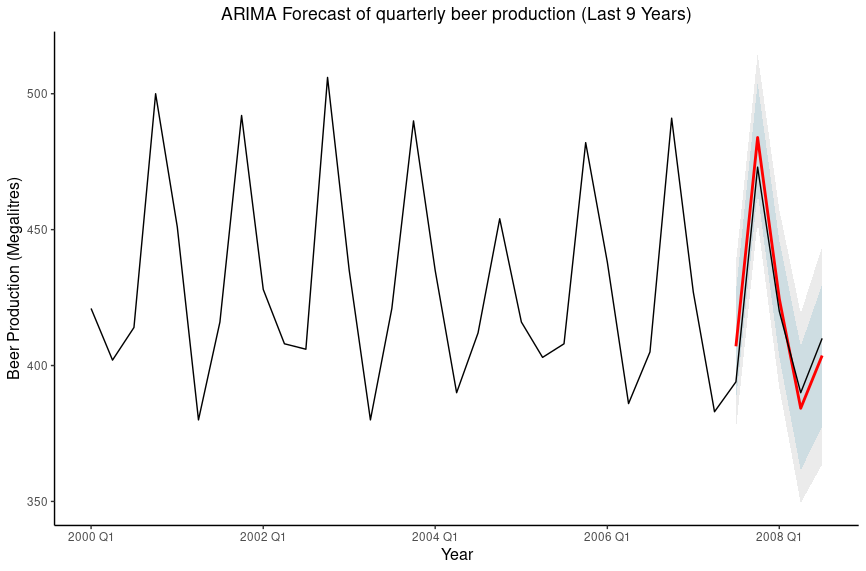
In red, the forecasted values for the last year, along with the bands for the 80th and 90th quantiles.
In black, the actual values of the series.
Anomaly Detection is a crucial application in sectors where identifying unusual patterns or outliers is essential for risk management. Time series analysis can help organizations monitor data in real-time and flag deviations from expected behavior. For instance, in the financial sector, anomaly detection can identify fraudulent transactions or unexpected changes in stock prices. In manufacturing, it can signal equipment malfunctions or quality control issues by detecting anomalies in production data. By swiftly addressing these anomalies, organizations can mitigate risks and prevent potential losses.
Overall, the diverse applications of time series analysis empower organizations to harness their data effectively, leading to enhanced decision-making, improved operational efficiency, and a stronger competitive edge in the marketplace.
Conclusions
In summary, time series analysis is a vital tool for understanding data points collected over time, allowing organizations to identify trends, patterns, and anomalies that inform decision-making. By defining time series and exploring its significance, we’ve highlighted how analyzing historical data can empower businesses to optimize their operations and improve efficiency across various industries.
The importance of time series analysis lies in its ability to provide insights that drive strategic planning. For instance, in finance, it helps investors make informed decisions based on historical price movements. In retail, effective demand forecasting minimizes lost sales while controlling inventory costs. In the energy sector, analyzing consumption trends enables utility companies to balance supply and demand efficiently.
Moreover, time series analysis supports organizations through its key applications: descriptive analysis reveals historical trends, predictive forecasting anticipates future conditions, and anomaly detection alerts businesses to unexpected changes. By leveraging these applications, organizations can enhance their processes, reduce risks, and maintain a competitive edge in the marketplace.
As industries continue to generate vast amounts of time-stamped data, embracing time series analysis will be essential for organizations seeking to navigate complexities and drive informed decision-making. The future of time series analysis holds great promise, offering even more sophisticated methodologies to unlock deeper insights and facilitate continuous improvement in operations.